|
|
|
Important Announcement and Call for Papers
The Kafka Society of America sadly announces the passing of Professor Walter H. Sokel, Honorary President and Co-Founder of the Society
The Kafka Society of America will dedicate their MLA Roundtable 2015, “Kafka and Memory”, and the next Journal issue to the recently deceased Kafka scholar Walter H. Sokel (1917–2014), who was a founding member of the Society and held many offices over the years, since 1975. He was last the Society’s Honorary President. His constant care and inspiration will be sadly missed. Walter Sokel’s research also includes aspects of memory in and about Kafka. For the MLA Session Roundtable, we invite presentations on cultural memories in Kafka scholarship; Kafka’s modernist texts; Kafka in comparison with his contemporaries; and Kafka’s distinct “direct style”. Kafka as a figure of cultural memory links the world before the Shoah, early modernism and religious traditions with post-1945 memory and postmodernism.
500-word abstracts are urgently requested to be sent by March 18, 2014 to and .
|
|
Modern Language Association Convention 2014
|
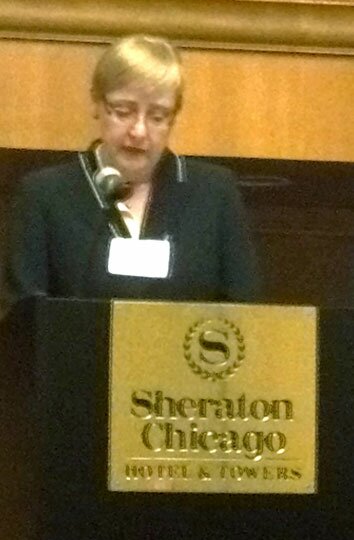
Dagmar Lorenz, Vice-President
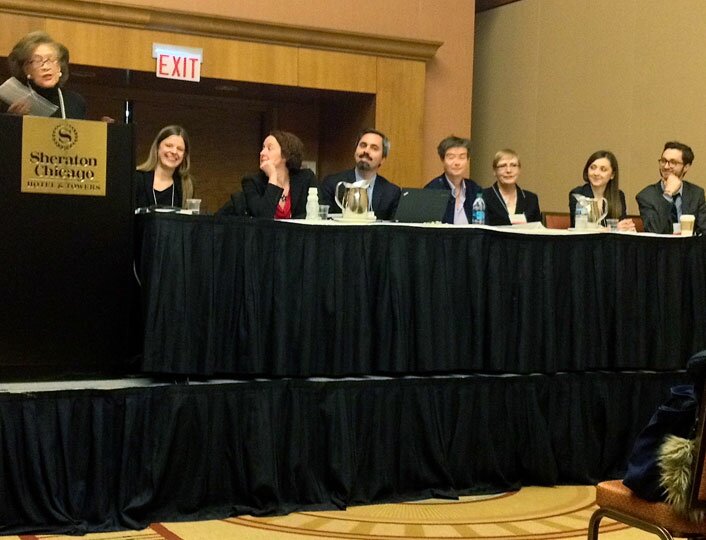
(Left to right): (podium) Maria Luise Caputo-Mayr, Executive Director, (panel) Sandra Fluhrer, Lynn Marie Kutch, Matthew Lau, Imke Meyer, Dagmar Lorenz, Lara Pehar, Sanders Creasy
|
|
|
Summary of the Kafka Society Roundtable Discussion
Saturday, January 11, 2014 — 5:15–6:30 pm, Sheraton 1, Sheraton Chicago — Chicago, IL
Presider: Maria Luise Caputo-Mayr
Respondent: Dagmar C. G. Lorenz
Special Session #636: “Kafka’s Experiments with Alternative Realities”
Connecting with the preceding Roundtable on Kafka’s influence on Post-Holocaust Literature and Film (MLA Boston 2013), the 2014 Roundtable further explores his works as historical documents pointing to contemporary issues and offering daring new visions at the intersection of the human-animal and human-object world, and other transient moments, “experiments” with alternative realities. While Kafka’s work does not portray his real life circumstances and his times in a realistic way, his lucid, terse prose with its “realistic details” is replete with allusions to them. These often find expression in his imaginary “creatures”, crossing the borderline between the human and the animal realm (horses, mice, dogs), and, similarly objects (the spinning top Odradek, the jumping celluloid balls) as characters that speak quite realistically and point to unexpected alternate existences. Such “experiments” comprise also alienating sites (the imaginary America, an unnamed castle, the imaginary Russia, the island of the “Penal Colony”). These presentations attest to the author’s wide-ranging intellectual interest and insights, his ability to incorporate many areas of knowledge, factual or utopian and to present them in unique artistic forms.
Sandra Fluhrer (Ludwig Maximilian University, München)
“Economy’s Comical Other—Kafka’s World of Remnants” / “Kafkas komische Restwelten” focuses on the origin and ontological status of “peculiar” creatures such as the horses in “Ein Landarzt”, the jumping balls in “Blumfeld”, Odradek in “Die Sorge des Hausvaters” to demonstrate how these are connected to Kafka’s procedure of testing language, namely, approaching the inexplicable through minute description. She applies Freud’s economic concept of the “comic” proposing that Kafka posits an alternative to the rational, purpose-directed economy of his time. Suspending the economy of cause and effect, according to Fluhrer, reveals the origin of the obscure.
Lynn Marie Kutch (Kutztown University, Kutztown, PA)
“Exploring Comic Worlds” refers to Kafka’s wish in a letter to Kurt Wolff (1915) to omit any drawing of Gregor’s insect shape on the cover of his book. Based on a 2011 article by Peter Beicken, Kutch draws two possible conclusions: That either Kafka’s text’s verbal immediacy needed no graphic presentation and/or that his very language made the “transmedial” approach of Eric Corbeyran’s illustrated text adaptation possible. The latter, a new comic leading into a Kafkaesque “alternative reality” makes the reader return to the original text.
Matthew Lau (Queensborough Community College—CUNY)
“Unheard Melodies and Varieties of Utopia in Several Kafka Texts” : A comparative analysis of the role of music in “The Metamorphosis”, “The Silence of the Sirens” and “Josephine the Singer”, drawing on ideas by Charles Rosen, Walter Benjamin, and Judith Butler for the argument that Gregor’s sister Grete’s mediocre violin playing and, in a different way, the silent sirens, point to a fleeting fragile utopia, whereas Josephine’s “piping” creates an image of communal solidarity. Tone-deaf Kafka’s fascination with the idea of music (rather than its execution) showed an affinity with modernist musical techniques, notably, the “Sprechgesang” and utopian “unheard melodies”.
Imke Meyer (University of Illinois at Chicago)
“Other Subjects: Kafka’s ‘Bericht für eine Akademie’” investigates the ape’s report as one of the most incisive critiques of Enlightenment models of education and subject formation in Kafka’s work and in his era. Rotpeter’s enforced journey to Europe becomes a perverted “Bildungsreise”. Rotpeter’s transformation into an educated creature produces the vexed image of the emancipatory promise at best. The dilemma of Kafka’s misguided creature fundamentally questions the Humanist educational agenda and the dilemma it creates by trying to lift all creatures out of a state of “Unmündigkeit”.
Lara Pehar (University of Toronto)
Drawing on Lacan, Bernheimer and E. Boa points to serious incongruities in Kafka’s “Castle” regarding narrative unity, defying completeness in his final novel. The incongruities suggest alternative narrative realities exposed by a protagonist who inverts difference and sameness in perception; she emphasizes that despite corrections from the locals, K.’s vision prevails. He collects “Schlossgeschichten” told to him, takes control of these texts, and does not survey the castle’s physical land, but its narrative landscapes. The novel could be read as the product of Kafka’s experimentation with alternative narrative forms, a carefully crafted hypertext without beginning and ending, proliferating into different directions. K. is integral to the text and at the same time its creator.
Sanders Creasy (University of California, Berkeley) [Substitute]
“Litera Mortua. Unreal Corpus” will focus on Kafka’s “Das Urteil”, and its relation to his journals in which Kafka wrote the story. It will address a formal gesture, in which a process of literalization—or embodiment—denatures the “reality” or consistency of the diegetic world. In turn, Kafka’s journals show him redoubling this gesture in relation to the story as a part of his quotidian world.
Substitute Speakers
Andrea Dahlmann-Resing (The University of British Columbia)
“At Arm’s Length, by a Hair’s Breadth: Evolutionary Imagery in ‘Der Verschollene’ and Georg Kaiser’s ‘Die Koralle’”. Linking both works with evolutionary discourse, as debated in early 20th Century Prague: With examples like chase scenes and their abrupt and continuous elements of locomotion, evolutionary principles of saltation and gradation become evident. Differences in footing are further negotiated in both pieces’ use of visuals: from seemingly sessile statues that turn into a charade of pedestals and props, to corals that exemplify their own way of cloning and fail to assign identity and place.
Phillip Lundberg
“Dieseits–Jenseits: The Divine and Worldly realms—An Analysis of the Parable ‘Before the Law’” : Josef K.’s self-delusions, resolving the supposed “contradictions” in the parable, the priest’s presentation of a range of opinions. Coming to terms with the “Naïveté and Arrogance of the Guardian” as well as the “childish fantasies” as regards the Interior Realm—its appearance and meaning. Modern man’s befuddlement and retreat before the spiritual realm is foreordained by Kafka in Josef K.’s haste to leave the Cathedral.
|
|
Message to all Members of the Kafka Society of America
While the Society wishes you all Happy Festivities and thanks for joining us in our efforts, we ask you the favor of checking your dues payments for 2012–2014 and kindly remit them. We are also sending you our Amended Constitution, December 2013 and ask you to vote on it.
|
|
Modern Language Association 2013 KSA Program
Preview of the Kafka Society Roundtable Presentations
Boston, MA; January 2013
The Roundtable discussion deals with recent writers, filmmakers, and visual artists. The Kafka factor in film and in the visual arts is an important aspect since Kafka has inspired noted filmmakers including O. Welles, S. Soderbergh, and M. Haneke. Kafka’s enduring importance is also evident from the production of second- and third-generation post-Shoah writers and filmmakers. Clearly, his particular approach to reality informs postmodern art and animation.
The connecting thread between the first four contributions is the question how to respond to brutality, terror, and alienation. The visual arts component brings a new dimension to the depiction of the invariably sinister situations that extend to contemporary political conditions. The observations on Welles present an approach for a new political Kafka interpretation.
K.L. Johnson
Resistance after Josef K. proceeds from J. M. Coetzee’s references to Kafka’s “The Trial” in his novel The Life and Times of Michael K, and attempts a “bio-political” interpretation that avoids a merely historical or existential reading. Johnson expects the inclusion of a post-Holocaust perspective to reveal hitherto unrecognized forms of passive resistance, even “under conditions of abjection.”
L. Wolff
Inhumane Bureaucracy and Inexplicable Guilt: Echoes of Kafka in H. G. Adler’s Literary and Scholarly Works discusses the transition in Adler’s oeuvre from Holocaust documentation (on Theresienstadt and Auschwitz) to fiction, notably the modernist episodic novel “Panorama” (1948, publ. 1968; transl. 2010). In conjunction with an exploration of the term “post-Holocaust” literature, Wolff identifies Kafkaesque elements and strategies as well as connections to Kafka’s life and suggests that the fate of the protagonist, Joseph Kramer (J. K.!), who is subjected to forces alleging his guilt, continues to be highly relevant today. She raises the question of the prophetic quality of Kafka’s work with regard to the bureaucratization and dehumanization under Nazism and beyond.
M. Modlinger
The theme of an inhumane bureaucracy is widened by M. Modlinger’s exploration of links between Kafka’s and Adler’s works, and their influence on W. G. Sebald’s “Austerlitz” (“The Kafkaesque in H. G. Adler’s and W. G. Sebald’s Literary Historiography”). Modlinger suggests that the imprisonment in Theresienstadt by an absurd and deadly system mirrors the situation in Kafka’s “The Castle” in reverse. Sebald’s novel adopts configurations developed by both writers in this “quest for identity and recognition…/and/…for history and memory.” Theresienstadt (near Prague) is the historic manifestation of Kafka’s castle with Adler and Sebald acting as surveyors of the “borderland between witnessing, memory and poetics.”
P.H. Kucher
Kucher points out a reversal of sorts also occuring in the best-selling novel of Holocaust survivor E. Hilsenrath, “Der Nazi und der Friseur” (1971). The theme of an “alienating brutal power” is manifest in the absurd story of an SS-man with the appearance of the stereotypical Jew of Nazi racial science, Schulz, who can adopt the identity of his Jewish childhood friend he murdered. Because of his familiarity with Jewish culture and Holocaust history, Schulz joins the Zionist partisans and becomes an Israeli citizen. The provocative plot is informed by the concept of a fluid identity (as a role play), reminiscent of Kafka. Past monstrosity is displayed with a highly irritating running commentary, employing the technique of “subversive speaking against moralistic post-Holocaust language.”
Concluding the presentations are two contributions from visual art/film:
S. Jacobowitz
Jacobowitz presents new aspects of the Kafka factor in five award-winning graphic works that engage with Kafka’s works and transcend disciplinary boundaries. Two of them are films. They explore themes such as Kafka’s criticism of family and society, alienation, persecution, and the grotesque struggle with bureaucracy. Shaun Tan’s “The Arrival” (2006) features frightening and wondrous visuals without text. A. Bechdel’s “Fun Home. A Family Tragicomic” (2006) revolves around a dysfunctional family; G. L. Yang’s “American Born Chinese” (2006) thematizes fitting in and dual identity, M. Satrapi’s “Persepolis” (film 2007) illustrates an exiled Iranian girl’s experiences in Vienna and Paris; A. Folman’s “Waltz with Bashir” (film 2008 and book 2009), explores personal experiences of the Holocaust generation and the filmmaker’s involvement in the Palestinian conflict.
I. Lewit
Welles’s Dekaf: De-Kafkaing as a post-Holocaust reaction in Orson Welles’s “The Trial” discusses Welles’s film version of “The Trial.” Lewit suggests that the Holocaust “functions in the film as part of the strategy Welles incorporates in order to shift ‘The Trial’ from a metaphysical notion of absence into a political notion of oppression.” This shift motivates Welles’s departure from Kafka’s text, and, by adding Holocaust remarks, reveals—according to Lewit—the filmmaker’s critique of the “Kafkaesque” and notions of political conspiracy.
Substitute: U. Katawal, Personal and National Allegories in Salman Rushdie’s Luka and the Fire of Life (SUNY Binghamton) using “Kafkaesque metamorphoses” to read Rushdie’s novel.
Introductory Commentary: The Kafka Factor in Post-Holocaust Literature and Film
Dagmar C. G. Lorenz, (Presider and Respondent of the Boston 2013 Kafka Roundtable)
University of Illinois at Chicago
At the special 2013 session organized by the Kafka Society of America in Boston, the topic under discussion was the “Kafka Factor in Post-Holocaust Literature and Film”. The MLA Kafka Roundtable “Kafka and the Holocaust” in Seattle in 2012 had brought to light connections between Kafka’s view of reality, processes leading up to National Socialism and the Holocaust in different contexts and inspired the panel on Kafka’s legacy in the post-Shoah world. With Ido Lewit (Tel Aviv University), Martin Modlinger (University of Bremen), Lynn Louise Wolff (University of Stuttgart), and Ubaraj Katawal (Case Western Reserve University), the panel examined the affinity of post-Shoah intellectuals and authors for Kafka as an author between the cultures, and his works that reveal in an unprecedented manner the disorientation and displacement of humanity in the twentieth century.
Kafka left his mark not only on literary authors, but became a force in the post-Shoah world, where he spoke to world audiences remembering the Second World War and the Holocaust and living under the threat of nuclear destruction and displacement. This condition has intensified from generation to generation, causing large populations to experience the kind of uncertainty and uprootedness for which Kafka, whose works date back to the era when these processes were set in motion, had found paradigmatic expressions. Indeed, in different cultural settings, Kafka is taught as if he were a local or even a contemporary author. He is included in the curricula of Humanities programs and English departments, and the repeated calls for new, accessible Kafka translations and the complaints that none of the existing translations do the author justice attest to the fascination with Kafka world-wide. The presentations at the 2013 MLA explored the Kafka phenomenon in its international, transgenerational, and transdisciplinary dimensions and identified its presence in different genres and traditions.
Kafka’s legacy expands as the author’s influence on contemporary writers, filmmakers, and artists shows. Many of them display a specifically Kafkaesque sense of being in the world and an appreciation for the absurdity of existence encapsulated in Kafka’s writings, which in a unique way have shaped today’s perception and interpretations of the human experience. The Kafka factor is present in all genres, most notably in film and the arts. Kafka has inspired filmmakers such as Orson Welles, Steven Soderbergh, Michael Haneke, and Vladimir Michalek (adaptation of Amerika) or Koji Yamamura’s short film of Ein Landarzt. Other films have been inspired by Kafka motifs, for example, David Cronenberg’s science fiction film The Fly. In addition, there are countless Kafka documentaries.
The panelists explored iconic works and uncovered ways in which existential uncertainty and alienation characteristic of Kafka’s works shape postmodern sensibilities. There are authors, interpreters, and translators who have conveyed the latter to the English-speaking readership, notably Prague-born Holocaust survivor H.G. Adler. Adler came from Kafka’s world and continued his career as a writer in England. His narratives about the horrors of the Shoah, recently translated by Peter Filkins, kept the memory of pre-Holocaust Bohemia and the destruction of this world alive in a literary approach that calls to mind motifs and ideas of Kafka. Adler had been a contemporary of Kafka and influential in the Austrian-British exile circles, including Elias Canetti, Franz Baermann Steiner and Erich Fried. Adler’s novels The Journey (2008) and Panorama (2010) are among the most important literary monuments dealing with the plight of individuals persecuted by the Nazis. Adler’s path-breaking documentation Theresienstadt. 1941-1945. Das Antlitz einer Zwangsgemeinschaft (1955) provided important impulses to younger authors such as W.G. Sebald. The new Adler translations are rekindling interest in the prewar Prague literary and intellectual circles in which Kafka would had participated. Moreover, the translations heighten the awareness of the devastation of Kafka’s intellectual home, German-speaking Jewish Prague, and add to the element of individual tragedy that of tragedies of social and cultural scope resulting from the dispersion and extinctions of intellectual traditions and communities. In this light, the re-examination of Kafka’s nightmarish visions—even though they predate the Holocaust—seems especially significant since they capture cultural trends pointing towards self-destruction and destruction and thereby seemingly preempt the trauma of genocide.
The panel mapped a variety of approaches of the Kafka tradition: Lynn Wolf, in her discussion of H.G. Adler’s Eine Reise, explored the author’s association with the Prague school. Adler’s literary works may be overshadowed by the study on Theresienstadt, but in the circles of Canetti, Fried and Franz Baermann Steiner, he was acclaimed as a cultural mediator and a link to the following generation of authors. Martin Modlinger raised the issue of inexplicable guilt as a central motif in Kafka, and he discussed situations of exclusion or non-admittance, notably, “being locked in” as in the erstwhile Habsburgian fortress and later Nazi concentration camp Theresienstadt, in contradistinction to being locked out. He argues that Adler and, later, Sebald connect with Kafka “in order to write their way into the darkness of history” and points out that both authors’ literary historiographies survey in a Kafkaesque mode “the borderland between witnessing, memory, and poetics”. Primus-Heinz Kucher analyzed the topos of identity change and the haunting by a horrific past in Edgar Hilsenrath’s novel The Nazi and the Barber. The grotesque, a key element in Kafka’s work, is taken to the extreme in Hilsenrath, with the exception that the latter’s plot is entirely intelligible while Kafka’s is opaque.
In a transmedial analysis, Ido Lewitt offered a new reading of Orson Welles’s film The Trial, maintaining that Welles was convinced that Kafka would have written differently after the Shoah. Supposedly in an attempt to safeguard the humanist element against the Kafkaesque mode, Welles, according to Lewitt, makes changes to Kafka’s narrative. While the responses to oppression and terror are central to the presentations discussed first, Lewitt’s new Welles interpretation points to aspects of Kafka criticism that were already advanced by Lukacs and Socialist functionaries such as Alfred Kurella. Ubaraj Katawal opened the intercontinental perspective by addressing the issue of exile in the contemporary world. He traced personal experience and national allegory in Salman Rushdie’s Luka and the Fire of Life, discussing the novel on the one hand as a literary contribution to the project of saving humanity “from forgetting their stories, the fire of their lives” but on the other hand, Katawal diagnoses Rushdie’s desire to “step across petty national, religious, and cultural borders in order to free himself from the prison-house of exile.”
The discussions following the papers probed into the question of whether the continued, if not increased, significance of Kafka for all genres and forms of expression addressed by the panelists might go along with mentality shifts since 1945 that engendered a global preference for the kind of aesthetics realized, early on or perhaps even prematurely, in Kafka’s fiction and autobiographical writings.
|
|
|
|
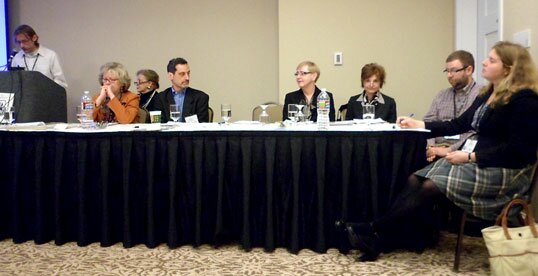
(Left to right): Panelists Alexander Erik Larsen (standing), Kathi Diamant, in the background Maria Luise Caputo-Mayr (Executive Director), Jeffrey A. Grossman, Dagmar C. G. Lorenz (also new Vice-President of the Society), Eva B. Revesz, Joseph W. Moser and Saskia Ziolkowski.
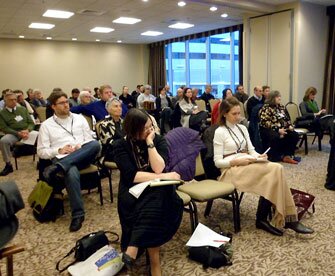 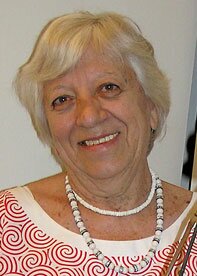
(Left): The audience at Kafka Roundtable 2012. (Right): Elisabeth Rajec, newly elected President of the Society (photos by Elisabeth Rajec and Marica Grofno)
|
|
THE KAFKA SOCIETY CONVENTION PROGRAM
Seattle, WA; January 2012
Saturday, 07 January 2012
8:30–9:45 am, Jefferson A and B, Sheraton
(Sheraton Seattle, 1400 6th Ave.)
Kafka and the Holocaust
A Special Session
Presiding: Marie Luise Caputo-Mayr, Temple University, Philadelphia
Speakers
Kathi Diamant, San Diego State University
Jeffrey A. Grossman, University of Virginia
Alexander Erik Larsen, University of Notre Dame
Dagmar C. G. Lorenz, University of Illinois, Chicago
Joseph W. Moser, Randolph Macon College
Eva B. Revesz, Denison University
Saskia Ziolkowski, University of California, Berkeley
This roundtable will address historio-biographic issues, including the confiscated papers from D. Diamant’s home and Primo Levi’s Trial translation, as well as Kafka’s literary legacy: Aichinger’s Jewish identity crisis, Schindel’s Born-Where, and countermyths to European enlightenment.
|
|
Abstracts of the KSA Roundtable Presentations
Modern Language Association 2012, Seattle
Kathi Diamant
Report on the results of the Kafka Project/SDSU research efforts in Berlin, Germany, June–Sept 1998 and Eastern Europe in June–July 2008 and future plans for Poland in 2012–13.
The Kafka Project is an independent international investigation into the lost work (35 letters and 20 notebooks) written by Franz Kafka in the last year of his life and confiscated from his last love Dora Diamant by the Gestapo in Berlin, 1933. Building on the search begun in the 1950s by Max Brod and Klaus Wagenbach, the presentation will reveal the significant discoveries and plans for the continuing search in Eastern Europe.
Jeffrey Grossman
Franz Kafka: Prophet of the Holocaust or Avant-Garde Writer with a View to Politics?
The suggestion that Kafka had “premonitions of impending disaster” and should be read in relation to the Holocaust seems to re-introduce through the back door the image of Kafka as “prophet of the Holocaust.” Though seductive, this paper will argue against such a view. Rather, it argues, Kafka responded to both bureaucracy, even in its potentially violent forms, and to the political situation of Jews in Europe, but that these responses do not amount to “prophecy”—of the Holocaust or otherwise—not least since the Holocaust was unforeseen even by its perpetrators until they began to actually implement it.
Alexander Erik Larsen
Emerging Machines: “In der Strafkolonie” and Kafka’s “Distressing” Times
While commenting on the brutality depicted in his “In der Strafkolonie,” Kafka suggested that, “distress is not peculiar to this story alone…our times in general and my own time have been distressing as well and continue to be so…” This paper will explore such “distress” through the execution machine, which stands as a chilling portent of the union of perverse ideologies and modern machinery expressed most intensely by the Holocaust.
Dagmar Lorenz
Kafka: the Touchstone of Aichinger’s Jewishness
Aichinger has been discussed as a Kafka adept, a notion she rejected in “Die Zumutung des Atmens.” Rather, she suggests that she avoided Kafka out of apprehension of what she might find in his writings. As already her novel reveals, her ambivalence involves identity issues she faced as the racially persecuted Catholic granddaughter of a Jewish grandmother, a Holocaust victim, and as the wife of a German author and war veteran. Kafka, the author and the person, represent for Aichinger the touchstone of her Jewishness. He attracted and at the same time deterred her.
Joseph Moser
The Kafkaesque in Robert Schindel’s Novel Gebürtig
Robert Schindel’s 1992 novel Gebürtig is a great example of Kafka’s post-Shoah legacy, as this book shows Hermann Gebirtig, a Holocaust survivor and Viennese Jew returning from New York to Vienna, where he is to testify in a trial against Egger, a cruel guard of the KZ Ebensee. Gebirtig encounters numerous obstacles in Vienna and with the Austrian justice system, which works against him, in part reminiscent of Kafka’s Trial. There is a deep sense of distrust and paranoia as a result of the trauma of genocide, both on the part of the second generation of Holocaust survivors and non-Jewish Austrians.
Eva Revesz
Kafka’s Jewish Self-Hatred
My paper deals with the intersection of two varying though related strands of Kafka scholarship: first, Kafka’s own self-image as a Jew, specifically as a self-hating Jew, and second, his status as a prophet of the Holocaust. An inquiry into the reasons why Kafka’s reputation as a Holocaust prophet has all but dissolved fuels my paper. Why, I ask, has Kafka’s one-time status as a visionary of the Holocaust been repressed from more current scholarship? And why has this reading of Kafka been displaced by his supposed Jewish self-hatred in more recent criticism?
Saskia Ziolkowski
From Kafka to Primo Levi: Jewish Kafka in Italy
Using Primo Levi’s comments on his translation process of The Trial as a starting point, this paper investigates Kafka’s role as “Jewish author” in Italy. Levi commented on the similarities between the world depicted by Kafka and his own experiences as one reason why the editors linked him and the German-language author: this paper explores how Kafka influenced other authors who considered him an emblematic Jewish author before and after the Shoah (Natalia Ginzburg, for instance, cites Kafka as the only Jewish bourgeois author she knew of growing up), as well as offering a treatment of one aspect of the under-examined relations between Kafka and the Italian literary landscape.
|
|
|
|
|
Top picture: Audience and panelists at Kafka Roundtable 2011; Second row: Picture to the left: Panelists Janko Ferk, Chris Kone, Valerie Reed and Keith Leslie Johnston; Picture in the middle: Austrian guest speaker Janko Ferk and Maria Luise Caputo-Mayr, Director of the Kafka Society. (photos by Sandra Agnoli)
|
|
THE KAFKA SOCIETY CONVENTION PROGRAM
Los Angeles, CA; January 2011
Sunday, 09 January 2011
8:30–9:45 am, 301B, LA Convention Center
Interpreting Lives in Kafka’s Short Stories
A Special Session
Presiding: Marie Luise Caputo-Mayr, Temple University, Philadelphia
Speakers
Peter Beicken, University of Maryland, College Park
Janko Ferk, Alpen-Adria Universität Klagenfurt*
Keith Leslie Johnson, Augusta State University
Christophe Koné, Rutgers University, New Brunswick
Valerie Reed, University of Nevada, Reno
Kafka’s works at one level present and represent narrated lives at a crucial cultural and historical crossroads of Western civilization a hundred years ago. Eschewing realistic hard data, his works capture essential problems of his (and our) time, perceiving it as harboring evil. Selected prose pieces (“The Metamorphosis,” “The Judgement,” “Jackals and Arabs,” “Report to an Academy,” “The Burrow” and “The New Advocate/Dr. Bucephalus”) show how these mini-biographies and mini-autobiographies illuminate general life circumstances, exploring recent theory and adding a somewhat new perspective to the larger issue of narrating lives. Kafka’s recently published life documents (his office prose) and Stach’s new biography add background to these approaches, connecting his work and the fictional lives he created. New legal connections will be illustrated by Janko Ferk’s research.
* Janko Ferk’s appearance was sponsored by the City of Klagenfurt, Austria
|
|
Modern Language Association 2009
|
THE KAFKA SOCIETY CONVENTION PROGRAM
Philadelphia, PA; December 2009
Tuesday, 29 December 2009
3:30–4:45 pm, Loews Philadelphia
Kafka Anew: Life, Work, Translations
Program arranged by the Kafka Society of America
Presiding: Marie Luise Caputo-Mayr, Temple University |
|
Matthew Powell
Walsh University |
Searching Kafka’s Diaries for the Untold Story |
Marjorie Edna Rhine
University of Wisconsin, Whitewater |
Kafka’s Epistolary Project: Translating Libidinal Energies in
“Letters to Felice” |
Phillip Lundberg
Bridgewater, NJ |
“Essential Kafka”: Translating What’s Written In Between the Lines |
Catriona MacLeod
University of Pennsylvania |
Kafka’s Amerika: Lost (and Found) in Translation |
|
Wednesday, 30 December 2009
1:45–3:00 pm, Loews Philadelphia
Kafka Anew: Multiple Perspectives
Program arranged by the Kafka Society of America
Presiding: Mark Harman, Elizabethtown College |
|
Pamela S. Saur
Lamar University |
Conversational Interactions in Kafka and Pinter:
A Linguistic Analysis |
Shambhavi Prakash
Rutgers University |
Sonorous Intrusions: Translation of Sound in Kafka’s Der Process |
Agnes Malinowska
University of Chicago |
The Cloudy Spot at the Center of the Father’s Concern: Kafka and Benjamin on Legal Violence and Narrative Postponement |
Hugo Rios
Rutgers University |
Embracing Failure: Kafka on Film |
|
Modern Language Association 2008
|
THE KAFKA SOCIETY CONVENTION PROGRAM
San Francisco, CA; December 2008
Saturday, 27 December 2008
3:30–4:45 pm, San Francisco Marriott, Foothill E
Kafka, the Premier Practitioner of Labor Law in Central Europe
Presiding: Michael Levine, Rutgers University |
|
Ayad Rahmani
Washington State
University |
In the Belly of the Ship: A Demonstration of Machine Power
and Labor Relations |
Paul North
New York University |
Everything Succumbs to Building |
Megan M. Ewing
Princeton University |
From Burrow to Bureau: Ego Defense in Kafka’s “Der Bau” |
Respondent: Iris Bruce, McMaster University |
|
Sunday, 28 December 2008
12:00 noon –1:15 pm, San Francisco Marriott, Pacific Suite A
Kafka, Brecht and Labor
Presiding: Marie Luise Caputo-Mayr, Kafka Society of America |
|
Olaf Berwald
University of North Dakota |
Marsyas Skin Grafts: Brecht/Kafka Palimpsests in Volker Braun’s Poetics of Survival |
Jens Klenner
Princeton University |
Denken als Dienstleistung: Von Kopflangern und Handlangern in Brecht und Kafka |
Nicola Behrmann
|
Food Comes First: Labor and Poverty in Kafka and Brecht |
Respondent: Judith Ryan, Harvard University |
|
Kafka Society of America Prize for Emerging Scholars
|
ANNOUNCING THE WINNERS OF THE KAFKA SOCIETY OF AMERICA
PRIZE FOR THE BEST ESSAY BY AN EMERGING SCHOLAR
Among the many valuable scholarly submissions for the best essay prize, the Committee selected two outstanding essays and split the prize money of USD $2,000.00 between the two authors:
Keith Leslie Johnson, Brigham Young University, Provo, UT
Kafka: Toward an Ethic of the Creaturely
Sorin Radu Cucu, SUNY, Buffalo, NY
The Fantasy of the Invisible Master or the “Unnamable” in Kafka’s The Trial
The prize was sponsored by Franz Muster, Panoramic Windows and Doors, with the assistance of Dr. Brigitta Blaha, Austrian Consul General in New York City and members of the Executive Committee of the Kafka Society of America*. The winning essay was selected by a panel of experts.
*Kafka Executive Committee Sponsors: Stanley Corngold, Rolf J. Goebel, Clayton Koelb, Elizabeth Rajeck, Judith Ryan, Henry S. Sussman, Ruth V. Gross.
Kafka Society Members and Other Private Sponsors: Jennifer Geddes, Michael G. Levine, Breon Mitchell, Mark Harman, John Pizer, John Zilcosky, Marjorie Rhine.
We congratulate the winners and wish them a successful further career and thank again the sponsors of this prize. Note to the authors of the other prize submissions: You will be shortly contacted by the prize committee chair with further information.
|
|
Modern Language Association 2007
|
THE KAFKA SOCIETY CONVENTION PROGRAM
Chicago, IL; 27–30 December 2007
Thursday, 27 December 2007
3:20– 4:45 pm, Parlor C, Sheraton Chicago Hotels and Towers
KAFKA NOW: Kafka and Popular Culture
Presiding: Judith Ryan, Harvard University |
|
Randy Laist
University of Connecticut |
Kafka 2.0: YouTube Metamorphoses |
Marie Luise Caputo-Mayr
Temple University |
Their Take on Kafka Now: Recent Kafka Adaptations
on the New York Stage |
Henry S. Sussman
SUNY Buffalo |
Extraterrestrial Kafka |
|
Friday, 28 December 2007
12 noon– 1:15 pm, Parlor C, Sheraton Chicago Hotels and Towers
KAFKA NOW: Kafka and Recent Literature
Presiding: Marie Luise Caputo-Mayr, Temple University |
|
Jae Hee Chang
UCLA |
Kafka on the Shore and in Contemporary Japanese Literature |
Elisa Martínez Salazar
Universidad de Zaragoza |
Kafka in Spain at the Beginning of the 21st Century |
Mark Harman
Elizabethtown College |
Der Verschollene/The Missing Person Now:
Revisiting Kafka’s First Novel |
Mark Zisselsberger
SUNY Binghamton |
The Afterlife of Literature: W. G. Sebald and
Kafka’s Hunter Gracchus |
Substitutes:
Denise Huber, Harvard University
A Contrastive Study of Kafka and Pamuk
Daniel Medin, Stanford University
Poetic Belatedness in J. M. Coetzee’s At the Gate
Betiel Wasihun, Yale University
Franz Kafka’s America or Der Verschollene and Haruki Murakami’s Kafka on the Shore
Roman Halfmann, University of Xiangtang, Hunan, China
Kafka’s influence on the Far-Eastern Culture: The Riddles as Part of the Solution: Haruki Murakami and Franz Kafka |
|
Modern Language Association 2006
|
THE KAFKA SOCIETY CONVENTION PROGRAM
Philadelphia, PA; December 2006
Thursday, 28 December
3:30–4:45 pm, 203-A Convention Center
Kafka and His Factories: Industrial Kafka I: “The Real Thing”
Presiding: Marie Luise Caputo-Mayr, Kafka Society of America |
|
Benno Wagner
Universität Siegen |
Paris, 9-11-1911: Kafka's Poetics of Accident |
Patrick Fortmann
Tulane University |
By Accident: Risks and Dangers of Kafka's Automobiles |
Kata Gellen
Princeton University |
The Mass-Produced Word: Kafka's Newspapers |
Back-up candidates:
Tim Attanucci, Princeton University
Auto-Omnibus: Kafka‘s Machine Traffic
Barry Murnane, Freiburg/Breisgau
Kafka's Dead Letter Offices: Bureaucracy, Technology and Magical Thinking |
|
Saturday, 30 December
1:45–3:00 pm. Regency Ballroom C1, Loews
Kafka and His Factories: Industrial Kafka II: Factories and Systems of the Mind
Presiding: Henry S. Sussman, SUNY Buffalo |
|
Marjorie Edna Rhine
University of Wisconsin, Whitewater |
Manufacturing Discontent: Mapping Traces of Industrial Space in Kafka's Haptic Narrative |
Sorin Radu Cucu
SUNY Buffalo |
“Modern Times:” Kafka and the Mechanical Imagination |
Martina Lüke
University of Connecticut |
The Human Machine/The Human as Machine in the Death Factory: Technology as Mirror of Modernity in Kafka's “In Penal Colony” |
Rolf J. Goebel
University of Alabama, Huntsville |
Industrial Work as Urban Phantasmagoria: A Note on Benjamin
and Kafka |
Back-up candidates:
Allen Shelton , Buffalo State College
Capital of the Wide Green Swamps
Lawrence Nannery, Saint Francis College, Brooklyn
Kafka and His Factories |
|
Modern Language Association 2005
|
THE KAFKA SOCIETY CONVENTION PROGRAM
Washington, D.C.; 29–30 December 2005
Thursday, 29 December
1:45–3:00 pm, Georgetown East, Washington Hilton
Kafka and the Body Politic I: Contemporary Discourses
Presiding: Marie Luise Caputo-Mayr, Kafka Society of America |
|
Patrick Forman
Harvard University |
"Aus mir geschnittenes Fleisch:" The Body Politics of
Kafka Literature |
Eva B. Revesz
Scripps College |
The Human Beast: Kafka’s Concentrationary Universe |
David Suchoff
Colby College |
Kafka’s Jewish Politics: Zionism, Goethe and the Hidden
Openness of Tradition |
Arnd Wedemayer
Princeton University |
"Diesseitswunder:" Franz Kafka as Political Saint |
Respondent: Judith L. Ryan, Harvard University |
|
Friday, 30 December
12:00 noon –1:15 pm, Conservatory, Washington Hilton
Kafka and the Body Politic I: Contemporary Discourses
Presiding: Henry Sussman, State University of New York, Buffalo |
|
Esther Kirsten Bauer
University of Wisconsin,
Stephen's Point |
Lost Between Power and Desire: Franz Kafka’s Der Verschollene |
Olaf Berwald
University of Tennessee, Knoxville |
Polis, Solitude, and Solidarity: Soundings of Kafka in Weiss
and Canetti |
Lucian Ghita
Yale University |
Topographical Assemblages and Reconfigurations: The Politics of Space in Kafka’s The Trial |
Michael G. Levine
New York University |
Freedom of Speech: The Space of the Mouth in the Kafka Corpus |
Respondent: Iris Bruce, McMaster University |
|
Modern Language Association 2004
|
THE KAFKA SOCIETY CONVENTION PROGRAM
Philadelphia, PA; 29–30 December, 2004
Wednesday, 29 December
10:15-11:30 am, Washington B, Loews Hotel
Kafka and Music: The Theme of Music in Kafka’s Texts
Presiding: Marie Luise Caputo-Mayr, Kafka Society of America |
|
| Walter H. Sokel |
Josephine’s Songs and the Role of Music in Kafka |
| Stanley Corngold |
Kafka and the Several Senses of Music |
| Iris Bruce |
“Musikwissenschaft:” Kafka’s Sounds of Silence |
| John Hamilton |
“Ist das Spiel vielleicht unangenehm?:” Musical Disturbances and Acoustic Space in Kafka |
|
Thursday, 30 December
12:00 noon-1:15 pm, Regency Ballroom C2, Loews Hotel
Kafka and Music: Musical Pieces Inspired by Kafka
Presiding: Judith Ryan, Harvard University |
|
| Ruth Gross |
Finding the Right Key for Kafka’s "Castle:" André LaPorte’s Opera, “Das Schloss” |
| Martha Hyde |
Paradoxical Barriers and Morphing Forms: Gyorgy Kurtag's "Kafka-Fragments: op. 24" |
| Francien Markx |
Recomposing Kafka: Ernst Krenek’s "Sechs Motetten nach Worten nach Franz Kafka" |
| David Fulmer |
Breaking Boundaries: Pozzi Escot’s Chamber Music inspired by
"The Metamorphosis" |
|
Modern Language Association 2003
|
THE KAFKA SOCIETY CONVENTION PROGRAM
San Diego, CA; 27–29 December, 2003
Saturday, 27 December
5:15-6:30 pm, Coronado, San Diego Marriott Hotel
Global Kafka I
Program arranged by the Kafka Society of America
Presiding: Marie Luise Caputo-Mayr, Kafka Society of America |
|
Anne E. Jamison
Princeton University |
Representations of Czech Identity in Kafka: Problems of Minor Literature |
Marjorie Edna Rhine
University of Wisconsin, Whitewater |
Satanic Verses and Kafka’s Curse: Kafkan Echoes in Stories of Mutable Postcolonial Identites |
Joseph Reuben Metz
University of Utah |
Kafka Goes Global: International Connections and National Identities in Kafka's Der Verschollene |
Rainer Rumold
Northwestern University |
Kafka's Nomad Images, from Multilingual Borderland to Global Experience |
|
Monday, 29 December
7:15-8:30 pm, Torrey 2, San Diego Marriott Hotel
Global Kafka II
Program arranged by the Kafka Society of America
Presiding: Janet A. Ward, University of Nevada, Las Vegas |
|
Patrick J. O’Neill
Queens University |
Global Kafka: Translations, Readers, Texts |
Julius M. Herz
Temple University |
Kafka and the Slavic World |
Marie Luise Caputo-Mayr
Temple University |
Kafka's Reception in the Romance Language World |
Ruiqi Ma
University of California, Riverside |
“Kafka’s Influence on Post-Mao Chinese Writers |
|
 |